
On request from friends of the blog The Adventuring Party these are my notes on running large open tables. For background, while talking about Gygaxian tables with a large, rotating cast Savage, co-host of the Adventuring Party, mentioned the 'regular game with an irregular cast' that I used to run. As mentioned, we were never sure who would show up and sometimes it ran as seperate groups, depending on who was there when. Eventually my regular home game became a subset of that open table group but there were still irregular adventures run with the rest of the group as available over years. Nowadays we might call it an overly elongated funnel - a bunch of randomly generated characters thrown into hazard together until eventually out the far side a group of unlikely companions emerges.
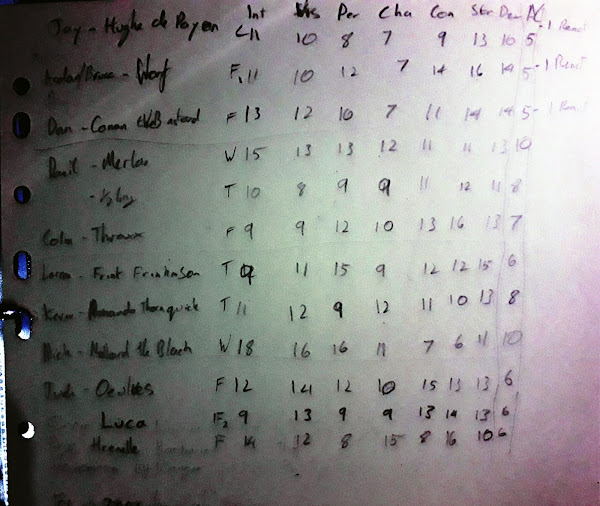
Roster of open-table regulars, circa 1997
The key point made in the description, that I want to dive into here is the question of whether there were any formal systems for managing all these players and their PCs - short answer no. The following are my lessons learned from running big tables - the key difference to standard (~6 or less) tables is you need to be extra sensitive to keep momentum up and make sure that everyone has something to do.


