24 November 2021

Attitudes of Lower Planar denizens

Setting up for a new Planescape campaign I was putting some thought into how to make the inhabitants of the Lower Planes feel different one from the other. There is already a good distinctiveness between the terrains of the different levels of the different planes and while it is fine if the devils, demons and daemons can feel similar wherever you run into them there should be something to differentiate the other planes.

This is an attempt to highlight the 'cardinal sins' of each of the Lower Planes to try and help make them feel different. There are a couple of places where there are similarities in terrain - floating lumps of hostile terrain in the darkness could be Acheron, Gehenna or Carceri - and so the attitudes of the inhabitants should make things distinct.

Icons from map of Outer Planes by Rob "Lazz" Lazzaretti


The lens I am taking here is that each of the planes has a over-arching bad vibe - not to say that it lacks all the others, just that in each place there is something that stands out.

Going plane by plane:

22 November 2021

Shiny TTRPG links #43

A collection of interesting TTRPG pickings from across the internet. More Shiny TTRPG links can be found on the previous list found here. The original inspiration for all of this - weaver.skepti.ch End of Week links. You can find still more links on the weekly blogroll on r/OSR.

Ashzealot writes a chunky post on Order and Chaos: a Physics Approach, a "personal interpretation of the original alignment axle" that sparked lots of discussions over the week.

Liches get stitches gives us mechanics for combat of the soul in Staring Contests

Cavegirl writes an interesting piece on 'Fuck Balance' and how mechanically unbalanced can be fun at the table.

Sorcerers Skull writes Everyone Comes to Sigil - on more ways to draw adventure from this multiversal neutral zone.

FOMORIANS (the Fhoi Myore from the Chronicles of Corum) on Shuttered Room.

Weaver.skepti.ch writes Exquisite Corpse - on randomly generating random tables around the table. Intriguing concept.

Human Non-Universals, or: Make Your Own Vancian Culture (tm) on Monsters and Manuals - really interesting flow and tables to cook up a culture.

An Alternative Take on Necromancy from The Orc Rehabilitation Commission, where the dead are cheap labour, first and foremost.

Eighth Eye writes up their houserules for carousing-for-XP in When It's Time to Party, We Will Always Party Hard

The XP Bowl and XP Bubbles - very interesting thoughts on an XP awards and rituals at table on Prismatic Wasteland.

World Building and Woolgathering writes The Rest of All Possible Worlds: The Anti-Grimoirean Thesis - describing the wave of consequence when "how magic works" changes

B'gutym, the Land of Grass and Stones, Vol II -- A Thousand Thousand(er) Islands Part I continues additional ATTI content on Box Full of Boxes.

Grumpy Wizard writes What is This Magic Sword For? - recognising that the sheer effort required for a magical sword implies someone had a point when they made it.

20 November 2021

This living rock, my brother - alternate dwarf culture: brazen dwarves

Dwarves are famous as iron workers but bronze is arguably the superior metal, iron is just more abundant and easier to work. Brazen dwarves are a convergent evolutionary species that occupies the same niche as common dwarves on other worlds.

The key aspects of the brazen dwarves
- non-standard senses and perceptions
- aesthetics of the living rock
- corporate city states with archives of secrets and ablative kings

17 November 2021

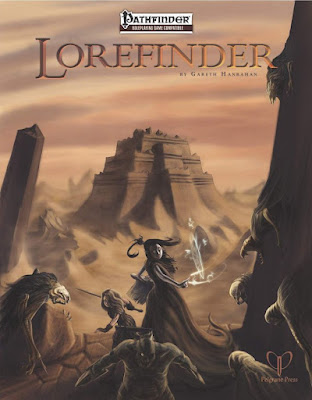
Review: Lorefinder

tl:dr; a great guide to modding D&D with GUMSHOE investigation systems to beef up non-combat. Written for Pathfinder, easy to mod for other editions.

I have heard good things about GUMSHOE and its focus on investigative games - especially on fixing the risk in standard D&D scenarios of 'everyone fails their rolls, you all miss the clue' which runs the scenario aground and requires the big railroading stick to be produced by the DM to get things moving again. Lorefinder in particular crossed my path as 'what you can use to play through the deep archive of Pathfinder adventure paths without having to go so deep into Pathfinder deep combat crunch. Combined that with the strong investigative tilt that some recent home campaigns took and I thought perhaps time to check out these new tools for fit.

Lorefinder cover by Christ Huth


I experienced this as getting the pdf and then printing a black and white copy so my view on the art, presentation is skewed. Overall its a slim line book packed full of useful content. So what are those contents?

15 November 2021

Shiny TTRPG links #42

The links that are the answer to life, the universe and everything. For more Shiny TTRPG links see the previous list found here. The original inspiration for all of this - weaver.skepti.ch End of Week links. You can find more links on the weekly blogroll on r/OSR.

Tales of the Grotesque and Dungeonesque creates "The Cult of the Rotmaiden" for Ravenloft but useable as scary druids anywhere.

Weaver.skepti.ch looks at Empire of the Deceased Sun a 'pico' game and setting in mythic Japan.

Alone in the Labyrinth pulls apart Ulysses 31 as an inspiration for OSR-in-space!

Alone in the Labyrinth writes "Generic Adventure Game: HIT PROTECTION & HIT DICE" - looking at mechanics for what happens at 0hp.

Kobolds from Pocketss - good example of what the kobolds are up to when you encounter them.

13 November 2021

Campaign Concept - Great Planar Scavenger Hunt

tl;dr: a campaign set up for touring the planes with a drop-in, drop-out table

Starting from a place where:
- opportunities to travel the stranger corners of the planes are limited - see the gaps in available adventures set on the planes
- planar exploration takes a distant back foot to rocking up and murdering the locals

I want a campaign skeleton that lets me delve into all the varied corners of the planes. I need a universal socket to support whatever planar one-shots I could come up with and after thinking for a bit what I arrived at this. We draw on two pieces of background inspiration - low background steel and the familicide spell from Order of the Stick.

How do those fit together? Glad you asked; our pitch:
Many elven populations are tied to a world tree in the deep woods of Arvandor on the plane of Arborea; each tree acting as anchor for all the souls of a particular world. When they die, this tie guides them to their rest. Long, long ago there was a world that was attacked during the Unhuman wars and devoured by a witchlight marauder. Some elves escaped that disaster long ago but are still tied to that tree of their now dead and barren world.

Recently, an elf became a problem for someone. That person consulted an oracle who told them - 'kill this tree and your foe will perish'. This was true but the unintended consequences are that all descendents of any elf from that world will also sicken and die.

The inhabitants of Arvandor realised what was happening and while the original tree is past saving, there is still time to transfer the soul anchor if another tree can be found from that world. Thus the task - help is needed to find wood that was taken off world before the world was destroyed. From fragments of wood, a new shoot can be encouraged but it needs to be found, scattered wherever across the Planes.

This is the pitch - each session would be the available heroes, mercenaries and adventurers being dispatched after a lead on a remaining fragment of wood. The cast could rotate. Difficulties could be tuned session on session for those available, assuming the desperate elves are spread very thin and using the minimum capabilities they can for every hunt to seek in as many locations as possible.

10 November 2021

What edition did you start with?

Matt Colville got a monstrous 12k response to "Which was the first edition of D&D you played?" so I swept up some comparable surveys to see if things had changed over time. Short answer, all is confusion and I think the answer depends on where you ask the question. Data is in table at bottom of page.

There were a couple of interesting things to read in all this:
That almost half of the respondents to the 2021 survey have started since 5e appeared ~6 years ago.
Apart from just before 5e dropped (2014), 4e never appears as the main on-ramp for players.
Just as 4e came out (2009) apparently the people playing had mostly started with 1e/2e.
The OSR Gateway people were only half actual old-school (pre-3e) players - the rest started with 3e/PF or later editions.

To me the only point that could be taken as 'confirmed' from all of these is that 4e brought a low fraction of todays players to the table. Most other surveys show closer to ~2/3 of players started playing with 3e/Pathfinder or an earlier edition.