Some suggestions based on my experiences with domain games.
- a light weight resolution system that spares a DM bookkeeping is probably a mercy
- structuring how you accept moves/turn orders/etc. so that it reins in players natural urge to leverage the whole realm they have access to is also probably a good idea
- some kind of shared forum, discord or other text based arena for players to negotiate and snarl and posture at one another is good because it makes visible all the activity to those who might otherwise miss it. Without that everything has to route through the DM and is another burden they need to shoulder.
- games like this are the ultimate 'split party' - everything a DM can do to spare their energies for juggling all the parallel threads is a good idea - light book keeping, light resolution, players directly and publicly interacting, etc.
This was started by conversation on discord prompted by the 'Cataphracts' game. I had the privilege to play in a couple of big domain games - two of Mike Rastons recent ones- Empyrean Dynasty and Sagadarium and two different ones back in my college days - and the common point of stress/failure was the processing load mid-late game puts on the DM as things get complex.


28 May 2025
Capsule Reviews #8: Recent Old School Adventures
Attronarch was selling off some adventures and I seized the opportunity - got a bunch of the OSE classic and thought I would run them against my Friday night open tables on the 'off weeks' of my dual mode game. This was an experiment on how old school adventures survive contact with 5e players - I also had Waking of Willoughby Hall on my shelves so threw that in too.
The three adventures run through so far are:
Waking of Willoughby Hall (for Knave)
Winters Daughter (for OSE)
The Hole in the Oak (for OSE)

Overall, all of these were pretty easy to use at table and supported a good session.
So what do you actually get in these?
The three adventures run through so far are:
Waking of Willoughby Hall (for Knave)
Winters Daughter (for OSE)
The Hole in the Oak (for OSE)

Overall, all of these were pretty easy to use at table and supported a good session.
So what do you actually get in these?
26 May 2025
Shiny TTRPG links #226
Choice links from about the internet. For more, see the previous list found here or on the weekly r/OSR blogroll or check the RPG Blog Carnival. Originally inspired by weaver.skepti.ch End of Week links.
Bocoloid from Southern Edge gives us The Moving West Marches: Adventures on the Red Caravan (and How to Run Your Own)
chipper-smol shares fun behaviors to give dragons that aren't feline/canine based
Behind the Helm writes Dungeon Replayability
Traverse Fantasy shared D&D Fifth Edition: Death & Rebirth
A Knight at the Opera gives us Look Before You Leap
Bjork's blog shares To Swear Upon the Mushrooms
VDonnut Valley gives us Vows as Social Standing and Social Structure
Ms. Quixotic Talks About Games writes Notes on adapting CATAPHRACT to my B/X game
Rise Up Comus proposes Worldbuilding through Saving Throws
Dice in the North shares Staying Organized
Tabletop Curiosity Cabinet gives us Replacing charisma: Standing
Bocoloid from Southern Edge gives us The Moving West Marches: Adventures on the Red Caravan (and How to Run Your Own)
chipper-smol shares fun behaviors to give dragons that aren't feline/canine based
Behind the Helm writes Dungeon Replayability
Traverse Fantasy shared D&D Fifth Edition: Death & Rebirth
A Knight at the Opera gives us Look Before You Leap
Bjork's blog shares To Swear Upon the Mushrooms
VDonnut Valley gives us Vows as Social Standing and Social Structure
Ms. Quixotic Talks About Games writes Notes on adapting CATAPHRACT to my B/X game
Rise Up Comus proposes Worldbuilding through Saving Throws
Dice in the North shares Staying Organized
Tabletop Curiosity Cabinet gives us Replacing charisma: Standing
24 May 2025
Baroque, Perhaps Impossibly Complicated Idea
Digging through ancient emails I stumbled across this ancient idea for a forum campaign and since I have not seen anything quite as convoluted around I present it for consideration in case someone can draw inspiration and maybe actually get it or something like it off the ground.
For background, the original pitch:
To frame this:
- the sequel campaign start-up - the actual forum game being played would have been 2009
- the original steampunk Alta-California Buffy/Stargate game should have happened in 2003-2004
The conceit was that it was the best game ever, with a team-of-heroes table, lots of legendary tales, etc.
Other context; this would have been played on a forum where there were a strong contingent of active readers - maybe two dozen - who would read nearly everything. This was the forum for our college games society, now long passed to dust. It had pedigree of numerous successful forum games, including the mighty League and curtailed League II, so we knew a game such as described here would have been 'played' but also 'put on' for the audience of forum readers. This would have been a bit of kayfaybe where everyone pretended to be in the know about this allegedly incredibly complex and awesome game.
For background, the original pitch:
Imagine, for a moment, we lived in an alternate universe, where I [had not immigrated] and ran a campaign [in 2004].
Now, this imaginary campaign was a lunatic Steampunk Buffy/Stargate crossover campaign set in Alta California (part of Imperial Mexico) circa 1990's where they found a 'stargate' in the Mayan ruins, not Egypt, in a world with a sort of Slayerverse level of background weird using Deadlands as the 'why'. It would have been D20 based using Monte Cookes WOD D20, Stargate D20 and Deadlands D20.
Ok, so my crazy notion is to run a thread on the gamers forum which would be the 'pre game setup' for the sequel campaign, or something like the 'league' threads that pop up now and then; creating the campaign retrospectively by tell the stories of the favourite bits from the first campaign.
The trick would be to pick the 'original' party - essentially an exercise in Fantasy RPG Game - choose your ideal player mix, ignoring geography and who was actually there at the time :) - and then those players would form the core of the thread and *within* the thread would stick to the define alt-reality; the game happened, these are true tales of the past. Outside, whatever, but this sequel campaign start-up thread would be played as a window into the timeline where it really happened.
To frame this:
- the sequel campaign start-up - the actual forum game being played would have been 2009
- the original steampunk Alta-California Buffy/Stargate game should have happened in 2003-2004
The conceit was that it was the best game ever, with a team-of-heroes table, lots of legendary tales, etc.
Other context; this would have been played on a forum where there were a strong contingent of active readers - maybe two dozen - who would read nearly everything. This was the forum for our college games society, now long passed to dust. It had pedigree of numerous successful forum games, including the mighty League and curtailed League II, so we knew a game such as described here would have been 'played' but also 'put on' for the audience of forum readers. This would have been a bit of kayfaybe where everyone pretended to be in the know about this allegedly incredibly complex and awesome game.
21 May 2025
Accordion Method Hex-filling (Hexcrawl25)
A daft name for the process I have been following of zooming back out to super-hexes pick up broader threads and presences about the map before zooming back in to populate sub-hexes.
So far I am operating at three scales - 40 mile super hexes, 10 mile hexes and 2.5 mile sub-hexes - this is partly due to a very old screw up in my mapping and lots of sunk cost. Use 3, 12 and 48 if you are doing this from scratch; it will mesh better with what most folk do.
My last write up was about zooming out to the neighbouring super-hexes because my party were dashing for the edges of their starting super-hex and I wanted to figure out what was likely to be found in bleed-over at the edges. It turned out to be very timely to do it in a systemic way because the next session they turned around and chased a quest they made up for themselves all the way across to the far side of the super-hex and threatened to head off the edge of that - happily I had also worked out what was off those edges. From being pointed west from the red splotch, they decided to head for the high terrain at the southern edge of the super-hex (yellow tags) so I decided to run another cycle of:
Setting hex themes and factions
Faction hex-sites
Hex-stocking by bleed-over
So here I had hexes AD (Baron), A11 (Rift Ruins), AE (Great Rise), D13 (Hissing Valley Miners), E9 (Jungle Marches) and E2 (Dead Mines) which I expanded a little to get a sense of what might be there.
AD - the Baron, outpost of the regional authority, nominally defending and taxing the mines and metalworkers around
A11 - the rift ruins - a broken open and corrupted insectfolk vault; bad insectfolk to contrast reasonable ones elsewhere
D13 - Hissing Valley Mines - iron mines feeding that super-hexes industry, run by traditionalist goliaths
E2 - the dead mines - undead-using mines run by Kirianshalee worshiping goliaths
E9 - Jungle marshes - border between the two goliath groups; lots of ore caravan raiding
AE - Great Rise - foothills to the mountains east/south east, home to cunning human traders
Each of these got a turn for a set of faction hex-sites for sub-hexes within their hex; each got
home base - a camp, tower, lair, whatever
'field activities' site with them actively doing something
'source of their power' location - herds, plants, etc.
minor outpost where they passively manage something
'goal' site in some other hex
The two goliath groups and the baron I had some notion of what they were up to but the cunning humans of the Great Rise were a bit of a mystery. Pondering on what they might be up to in the middle of a rainforest I decided their thing was birds; hunting them, falconing and making things from feathers.
For their sites I came up with:
Home Base - their overly welcoming raionforest village where they work hard to keep all their neighbours friendly
'field activities' - their eagle-falconing scouts keeping an eye on their surroundings
'source of their power' - feather-weaving artificers
minor outpost - canopy hides in their rainforest for bird-trapping
'goal' site elsewhere - a bird-hunting ground Then I did a grid of who would bleed-over into where; columns for the 'affected' hex and rows for the neighbour having an influence. Each cell then gave me a sub-hex. It also provided a good frame for 'who of that faction would be found abroad' which was a good prompt for what might be in encounter tables.
 For those same humans I figured that their neighbours were
A12 - the shadowed swamps
A11 - the rift ruins
E9 - the Jungle Marches
A5 - Foothills/backcountry
E2 - the Dead Mines
E8 - Plateau Rainforest
These provide another block of things to fill sub-hexes with and then zoom down to the remaining empty sub-hexes. Asking who all the neighbours are allows us to zoom out for another set of hexes which have been thought about, looking at the terrain, religious and cultural boundaries sparks ideas, factions can be picked and then we can zoom back in and run the cycle again.
I am finding myself more inclined to run this 'accordion' approach without fully populating all the sub-hexes, to leave some room for further ideas to be placed.
So far I am operating at three scales - 40 mile super hexes, 10 mile hexes and 2.5 mile sub-hexes - this is partly due to a very old screw up in my mapping and lots of sunk cost. Use 3, 12 and 48 if you are doing this from scratch; it will mesh better with what most folk do.
My last write up was about zooming out to the neighbouring super-hexes because my party were dashing for the edges of their starting super-hex and I wanted to figure out what was likely to be found in bleed-over at the edges. It turned out to be very timely to do it in a systemic way because the next session they turned around and chased a quest they made up for themselves all the way across to the far side of the super-hex and threatened to head off the edge of that - happily I had also worked out what was off those edges.
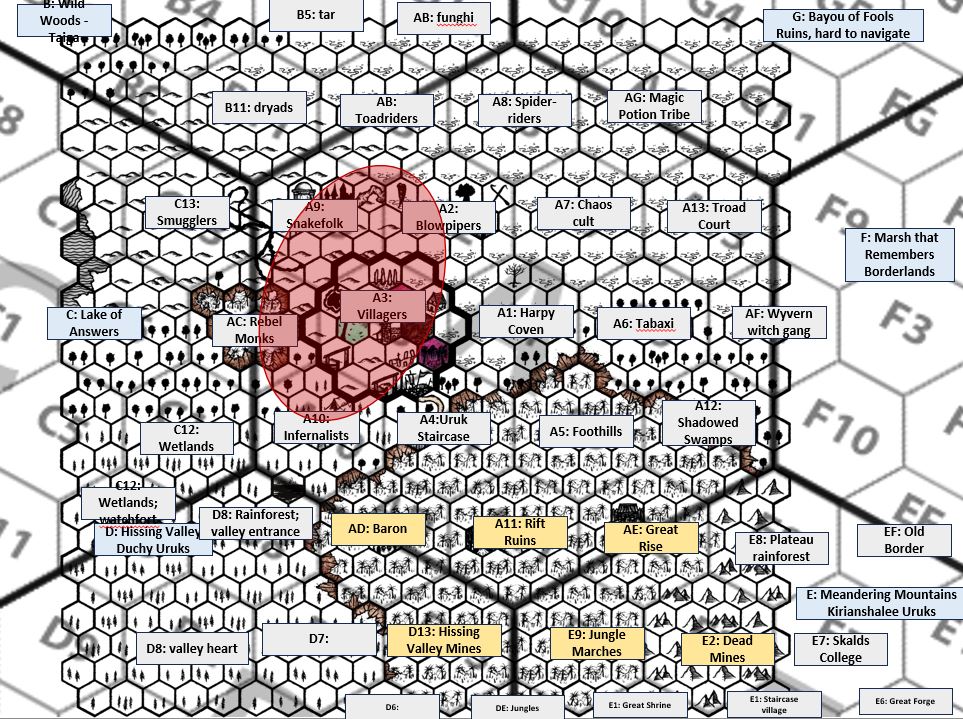
Setting hex themes and factions
Faction hex-sites
Hex-stocking by bleed-over
So here I had hexes AD (Baron), A11 (Rift Ruins), AE (Great Rise), D13 (Hissing Valley Miners), E9 (Jungle Marches) and E2 (Dead Mines) which I expanded a little to get a sense of what might be there.
AD - the Baron, outpost of the regional authority, nominally defending and taxing the mines and metalworkers around
A11 - the rift ruins - a broken open and corrupted insectfolk vault; bad insectfolk to contrast reasonable ones elsewhere
D13 - Hissing Valley Mines - iron mines feeding that super-hexes industry, run by traditionalist goliaths
E2 - the dead mines - undead-using mines run by Kirianshalee worshiping goliaths
E9 - Jungle marshes - border between the two goliath groups; lots of ore caravan raiding
AE - Great Rise - foothills to the mountains east/south east, home to cunning human traders
Each of these got a turn for a set of faction hex-sites for sub-hexes within their hex; each got
home base - a camp, tower, lair, whatever
'field activities' site with them actively doing something
'source of their power' location - herds, plants, etc.
minor outpost where they passively manage something
'goal' site in some other hex
The two goliath groups and the baron I had some notion of what they were up to but the cunning humans of the Great Rise were a bit of a mystery. Pondering on what they might be up to in the middle of a rainforest I decided their thing was birds; hunting them, falconing and making things from feathers.
For their sites I came up with:
Home Base - their overly welcoming raionforest village where they work hard to keep all their neighbours friendly
'field activities' - their eagle-falconing scouts keeping an eye on their surroundings
'source of their power' - feather-weaving artificers
minor outpost - canopy hides in their rainforest for bird-trapping
'goal' site elsewhere - a bird-hunting ground


A12 - the shadowed swamps
A11 - the rift ruins
E9 - the Jungle Marches
A5 - Foothills/backcountry
E2 - the Dead Mines
E8 - Plateau Rainforest
These provide another block of things to fill sub-hexes with and then zoom down to the remaining empty sub-hexes.

I am finding myself more inclined to run this 'accordion' approach without fully populating all the sub-hexes, to leave some room for further ideas to be placed.
19 May 2025
Shiny TTRPG links #225
Shiny links from about the web. For more, see the previous list found here or on the weekly r/OSR blogroll or check the RPG Blog Carnival. Originally inspired by weaver.skepti.ch End of Week links.
The Other Side gives us Why D&D 5.5 (2024) Needs a New Campaign World
Taskerland writes Home and Away – On RPGs and Community
GROGNARDIA gives us Save Versus Senescence
Snow’s Substack shares Kala Mandala - A Review
Mediums and Messages gives us Captain's GLoG - Intermezzo
Ward Against Evil writes Drama, Tension, and Roleplaying
The Black Citadel gives us Invoking Divinities in OSR Games
Alles Ist Zahl wrote Sharing the cognitive load
The Other Side gives us Why D&D 5.5 (2024) Needs a New Campaign World
Taskerland writes Home and Away – On RPGs and Community
GROGNARDIA gives us Save Versus Senescence
Snow’s Substack shares Kala Mandala - A Review
Mediums and Messages gives us Captain's GLoG - Intermezzo
Ward Against Evil writes Drama, Tension, and Roleplaying
The Black Citadel gives us Invoking Divinities in OSR Games
Alles Ist Zahl wrote Sharing the cognitive load
17 May 2025
Review: Scarlet Heroes
tl:dr; a cool system for running old school modules with not many players, with useful mechanics worth stealing for any game of yours.
I was vaguely aware of Scarlet Heroes for a bit but got a chance to play it when an old comrade decided to give some classic dungeons a go in a schedule-friendly format. The key concept beyind Scarlet Heroes is to provide an engine that allows solo-play or duet-play (GM+1) for old school modules which might have been written with a significant party of PCs plus hirelings in mind. "Sword and Sorcery Adventures for the Lone Hero" as it says on the front.
I grabbed my copy to play in that campaign, mainly for better character generation insight and to get a better grip on the rules than the quickstart provided and was pleasantly surprised by the 'creating adventures' chapter - another Kevin Crawford masterwork of tags and tables to aid DMs. Lots of the different components of this book have proved unexpectedly useful to me - for a game I sort of stumbled upon it has been one I have referred back to and pulled up for use far more often than I expected. A sleeper hit that keeps on giving.

First impression - arresting cover art; the kind of piece that speaks to the book having a vision that is both clear and distinct. Not your mushy generic fantasy, but something unusual like Tekumel or Earthdawn. It is unusual for a setting designed to host old school modules to be strongly east-asian flavoured since most of those old adventures were generic fantasy western europe but it works.
I was vaguely aware of Scarlet Heroes for a bit but got a chance to play it when an old comrade decided to give some classic dungeons a go in a schedule-friendly format. The key concept beyind Scarlet Heroes is to provide an engine that allows solo-play or duet-play (GM+1) for old school modules which might have been written with a significant party of PCs plus hirelings in mind. "Sword and Sorcery Adventures for the Lone Hero" as it says on the front.
I grabbed my copy to play in that campaign, mainly for better character generation insight and to get a better grip on the rules than the quickstart provided and was pleasantly surprised by the 'creating adventures' chapter - another Kevin Crawford masterwork of tags and tables to aid DMs. Lots of the different components of this book have proved unexpectedly useful to me - for a game I sort of stumbled upon it has been one I have referred back to and pulled up for use far more often than I expected. A sleeper hit that keeps on giving.

First impression - arresting cover art; the kind of piece that speaks to the book having a vision that is both clear and distinct. Not your mushy generic fantasy, but something unusual like Tekumel or Earthdawn. It is unusual for a setting designed to host old school modules to be strongly east-asian flavoured since most of those old adventures were generic fantasy western europe but it works.
Subscribe to:
Posts (Atom)